
Active-threat preparedness looks different across schools — but at AHS, ALICE training hasn’t been practiced for about 10 years. ALICE, which stands for Alert, Lockdown, Inform, Counter, and Evacuate, is a safety program designed to save lives during school emergencies. Yet most students at AHS have never experienced an ALICE drill, leaving some to wonder whether the school should reintroduce the training — and if so, how to do it in a way that prepares without creating panic.
Teachers at AHS vary in their knowledge of the ALICE training. History teacher Stephanie Kelley said, “I know what an adult’s response should be in the building. So I know how I’m supposed to respond to someone responsible for like 20 young people.” In contrast, Spanish and Leadership teacher Dan Vargason is well-versed in ALICE training. Vargason said, “We started doing this, I don’t know, my fourth year, third year here in Atlantic. And they cover it with us every year. In the first couple of years, they did some really in-depth training. And then annually, they review it with us.”
So what would they do if an active threat occurred or AHS held an ALICE drill? Kelley responded with “it’s going to depend on what they say, like what kind of instructions they’re giving us. If they’re telling me it’s like the other hallway, then we’d get the heck out of dodge. If it was right in my hallway or nearby, you’d better be darn sure we’d be figuring out how to close the curtains, get the door locked, and I’d be arming my kids with whatever Yetis there were. So we’d have plenty of things to bombard someone with if they were, in fact, able to breach the door.” Vargason said his response would depend on the situation. “If there’s somebody outside my room, we’re going to evacuate… If they’re telling me someone’s outside, we’re going to bunker down.” In a real emergency, he would “play it by ear,” contact 911, and choose to either evacuate or lock down based on what was safest.
Though they know what to do in a case of an actual emergency or drill, here’s what some teachers voiced as their questions and concerns: not having the training of knowing what to do when a kid is panicking, making any final decisions, Kelley said, “You are the one in charge of deciding for all the young people. And it’s the adrenaline that’s pumping through. And you’re trying to decide which one is going to make sure that my students are the safest. Do we run for the door? Do we barricade? Which one is going to get them furthest from harm? It’s a little different when it’s yourself. But when your choices impact 22-24 teenagers, it’s not the same kind of pressure. You’re going to second-guess your choice no matter what, especially if something happens. What could I have done better?” Vargason said the biggest challenges in an emergency would be getting past the initial shock — the “Oh my gosh, this is happening” — then relying on instinct and judgment to make decisions. He added that student compliance is also difficult, since kids may panic or not listen right away.
Despite the potential challenges, teachers agreed that preparation plays a major role in safety. This led to the question of whether students themselves would benefit from learning about ALICE. Kelley mentioned that she believes it’s beneficial to students. Kelley reflected on the balance between informing students and not overwhelming them — students need to know protocols, but “sometimes less is more” because too much detail can frighten people or even inspire harmful ideas. Vargason said he believes that students “100%” would. Vargason also said, “I know some people thought it was too much for kids and it’s traumatizing, but I think it’d be even more traumatizing if we had a school shooting and we were unprepared. So personally, I believe that yes, I think there should be ALICE drills. That does not mean it has to be full-scale. But, yeah, I do think students need to be informed and trained in it.”
Teachers voiced their opinion and said it’s important for students to know what to do in an emergency. Kelley emphasized the importance of knowing protocols during an emergency. She explained that with fight-or-flight responses, “if you don’t have any idea where you’re going or what the protocol is… it just causes a lot of chaos,” especially with so many students in the building. Vargason said that it’s “very important.” Vargason compared ALICE training to other emergency drills like fire and tornado drills, noting real past events at schools [The Middle School roof fire]. He said, “Hopefully we never have to deal with what ALICE requires, but we can’t bank on that,” and emphasized that it’s important for students to know what to do and to “listen as much as possible” to the adults giving wise instructions.
Would teachers support bringing back ALICE drills at AHS? Kelley said, “I think it’s valuable when done in a really responsible way. If students think it’s funny or they’re mocking it or just play-acting and doing that type of thing, I don’t think that’s valuable at all. In fact, I think that just cheapens the lesson or takes away from the seriousness of it. But if you have, maybe even just like a short walkthrough that’s paired with discussions. Here’s what we would do. Why would we do this? You know, do you think that this is a good idea and having kids dialogue a little bit about it, I think that’s how I would want to do it.” Vargason said, “I think that Alice drills are important and again, that doesn’t mean it necessarily needs to be a full-scale evacuation of the building, but I’m also not opposed to that either. But there needs to be something brought back. I think it’s incredibly important. Obviously, you can open the news up and see school shootings all the time. So the fact that we don’t do those, I think, is something that should be adjusted.”
Though teachers still have their concerns about bringing ALICE back. Vargason said his biggest concern with ALICE drills is communication with parents and the reactions they may have. He noted that some parents want to opt their children out, which “concerns” him because “you can’t opt out of a school shooting.” He also worries about students not taking the drill seriously, stressing it’s not a game but preparation. Kelley said there needs to be a balance in how ALICE drills are done. She doesn’t want them to become something students laugh about, but also doesn’t want kids to leave “freaked out” or suddenly feeling unsafe. Her main concern is finding a way to run the drill seriously without causing panic or turning it into a “mockery.”
How would teachers reassure students during an emergency but still follow safety protocol? Vargason said, “The biggest thing is to be confident. I think most teachers have played through the scenarios, unfortunately, in their heads. What would I do in this situation? So it’s just like anything else, you need to be confident. If kids don’t think you are confident, they’re not sure. They’re not going to trust you, follow you.” Lastly, what would make them feel more confident in their classroom safety plan, Kelley said, “There’s a way that you can take a chair, and you can put it under the latch.”
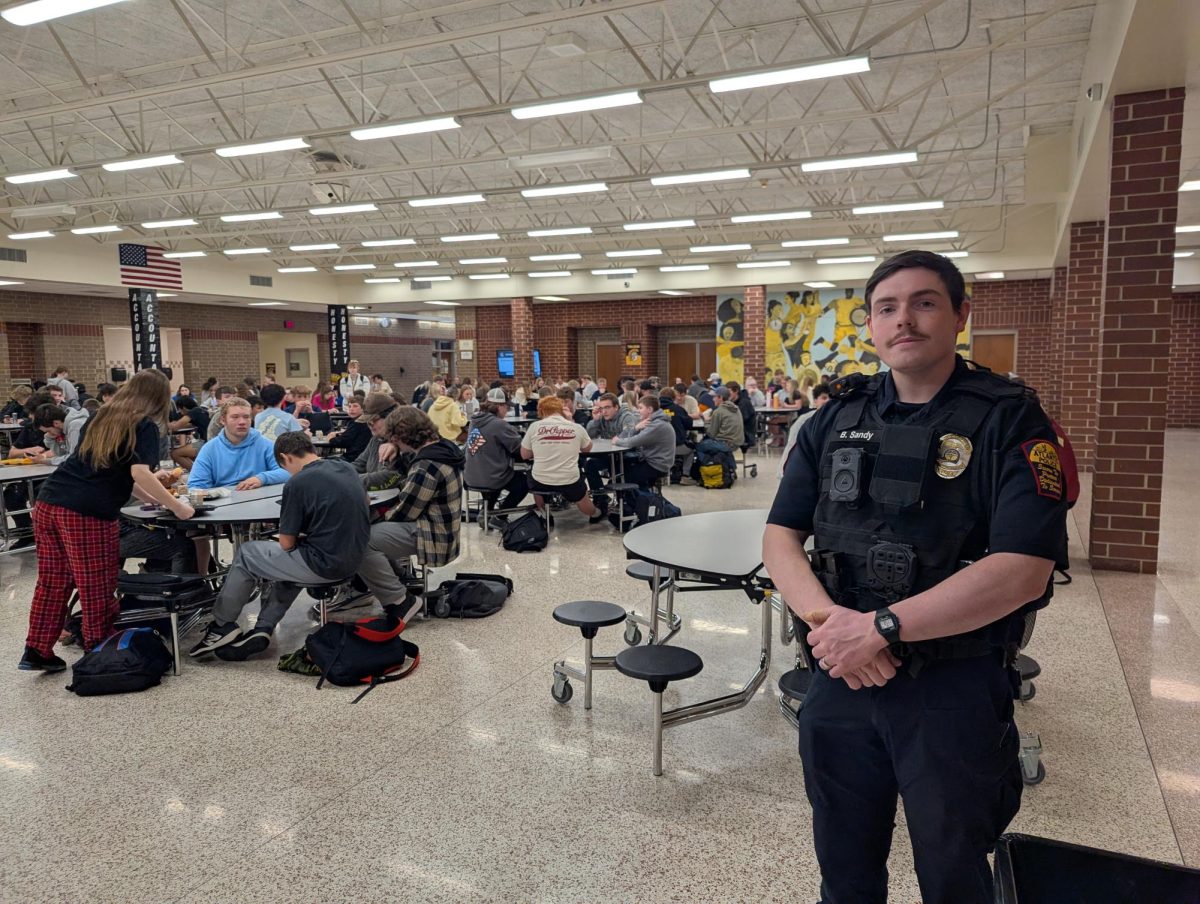
Officer Ben Sandy, as the school’s SRO, is one of the people who would be called in a case of an active threat in the ACSD. Law enforcement’s role in an ALICE event is to stop the threat. To gain a law enforcement perspective, he touched on the strengths and weaknesses of the ALICE approach from a safety point of view. Officer Sandy said, “The pros are it gives an idea of what to do in the event; for cons, it does give you options.” Following the discussion of ALICE’s pros and cons, Officer Sandy talked about whether he believed the program would improve safety at AHS. He said, “Yes, as the teachers are trained to Alice and to give students and everyone an idea of what to expect.”
Following the discussion on ALICE’s effectiveness, Officer Sandy was asked what essential knowledge students and teachers should have in an active threat scenario. Sandy said, “Most important is information about where the person is and figuring out what to do.” Next, Officer Sandy talked about how crucial it is for students to know what to do in a crisis. He said, “Very important because you get into an event you aren’t familiar with.” Officer Sandy was then asked a question about how the layout of AHS is, responding with “The layout is an interesting layout, which allows a bunch of different escape paths,” which then helps get students evacuated to safety. He said that other than ALICE, “there are a few different programs like ALERRT,” but it’s argued that it’s a law-enforcement program.
Officer Sandy also gave information on how police officers at APD help prepare/train teachers and staff to respond effectively during emergencies, stating that there was an “ALICE meeting for staff” in the auditorium approximately a week before the students came back to school.
What about a student’s perspective? Sophomore Clinton Brandon said, “I feel safe in Atlantic High School. But I feel like some teachers should be more informed.” Sophomore Bethany Brown said, “Like 80%.” On a student’s side, how confident are they in their teachers that they know what to do? Brandon said he’s very confident in his teachers, while Brown said, “I trust them.”
What do students wish the school would do to improve safety? Brandon said he “wished school would let us use our phones in emergencies like fires or tornadoes.” Brown said, “Figuring out how to lessen the drug problem.” Brandon said that learning ALICE makes him feel safer at school. He said, “Because it would explain what to do during emergencies.” But Brown said it would not make her feel safer.
From a student’s standpoint, how important is it for students to know what to do in emergencies? Brandon said, “It is very important so they don’t panic, get everyone else hurt,” and Brown said, “It is good to have a guideline to know what to do.” Though, would they support bringing it back? Brandon said, “I would,” while Brown simply said, “I guess.” Both students had no concerns or questions about whether ALICE was brought back to AHS. Both also agreed that students are currently well informed on what to do in emergencies.
Principal Heather McKay mentioned that the last time AHS had an ALICE drill was about 10 years ago on Nov. 4th. That brings up the question of why we haven’t had one in so long. McKay answered by needing to “review protocols” and needing to “reflect on them.” Though a big worry about ALICE is the community’s response to it, McKay said that as high school students, they’re more “mature to it” while the community would “hate that this is the world we live in” and “a world we have to be prepared for.”
In hopes of ensuring that students and staff are prepared for emergencies, McKay said, “Signs are posted in classrooms, [and] the radios are a big help.” McKay’s biggest priorities when it comes to safety at AHS are “looking through the building” and hoping to “change the security of the front entrance.” McKay also mentioned having “conversations with law enforcement regularly,” and that it’s “nice to have Officer Sandy here, he goes around and checks the doors to see if they are locked or not.”
McKay then answered how important she thinks it is for students to know what to do in an emergency, “not just here, but at home as well,” too, “think through your own homes as well.” She also said that it’s “very important for kids to know how to keep themselves safe.” Would McKay support bringing ALICE drills back? She answered, “Yes, I would, a lot is going into it,” but she also “wants to know where her kids are at” and “how they feel about that.” Bringing back ALICE can potentially cause fear among students, so how would we balance practicing preparedness without creating fear among students? McKay’s idea was to “use your resources, have a calm presence, be calm, honest, direct.” McKay wanted to make clear that if a threat were to get into a classroom full of students, they can protect themselves with anything in the room, remembering that when they first went to ALICE students would say they couldn’t throw that, McKay said, “Oh yes you can,” and saying “I don’t care, throw a textbook…when its your safety and the safety of others near you. Yeah, I don’t want you normally throwing textbooks, but if it’s going to save you and somebody else, you throw as many textbooks as you want.” If you have to decide to be safe in an event like that, “You don’t need McKay or teachers there to do it.” The biggest priority in an emergency is student and staff safety. AHS regularly talks with law enforcement, McKay said, “If they have a concern, they bring it to me, and vice versa.”







John McCurdy • Mar 25, 2026 at 11:22 am
Very in depth story! Nice job