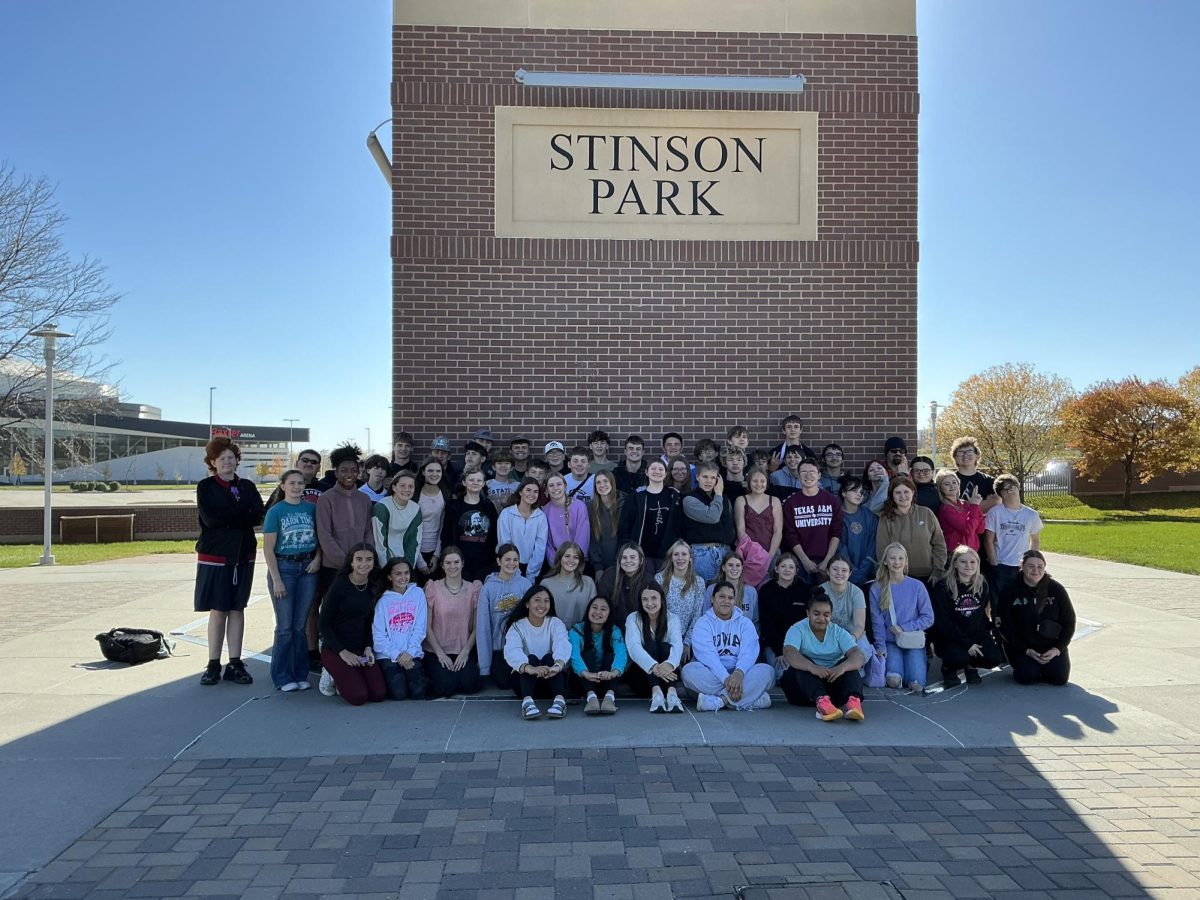
Students of three different freshman English and language arts classes boarded buses and headed out for the Samuel Bak Art Museum on the University of Nebraska Omaha campus on Friday, Nov. 7. “I’m excited to see things that weren’t told to us in our book,” said Miley Winford just before she visited the museum.
The book Winford was referencing was Night by Elie Wiesel. Night is an internationally acclaimed memoir of a Holocaust survivor from present-day Romania. All freshman ELA classes spent a portion of the first quarter reading and discussing this work. This was in preparation for the student’s trip to the Samuel Bak museum because Bak, like Wiesel, was a survivor of the Holocaust. One attendee, Liam Spencer, hoped that the trip would give him deeper insight into the book’s themes through another perspective on the same event. Spencer said, “It’s really interesting to see how someone can go from being innocent, then that switch just being flipped.” But this wasn’t the only thing on his mind. “I want to know how a lot of people escaped.”
The museum itself features art primarily from Samuel Bak, although his work is augmented by other artists to help visitors explore his works through comparison. According to Kati Larsen, the Director of Education at this museum, Bak was a Lithuanian Jew born in the town of Vilna in 1933. The pull of art grasped him at a young age, but so did the tide of the Second World War. Bak was forced to spend his childhood inside a ghetto, a sectioned-off part of a city meant to exclude Jews during German occupation. Through the war, he would lose family members and endure hardships, but was ultimately saved by the kindness of those who were willing to help him.
Bak’s art itself is comprised of paintings created in the style of magic realism. This means that while the paintings themselves are fanciful, offering images of people made of boards and floating items, they are also solemn or realistic, usually reflecting on emotions and events that occurred during Bak’s traumatic time in the Holocaust. Symbolism was heavy throughout his work, and it took some a bit of hard thinking to figure out. Harper Whitney, a student, said, “Everything became more mechanical, all the pears and the teapots and all of the motifs, kind’ve became patched together. They all had screws and knobs in them, and they weren’t what they actually are. And I think that shows how, after a traumatic event like that, people try to rebuild.”
There to help the students out with the deciphering of the symbolism was the museum staff. One guide, Emilia Dana-Munaz, readily talked through Bak’s motifs with the students.“Bak uses pears to represent the human form because of their shape and how they are easily bruised. There are also some biblical ties to the story of Adam and Eve and how, in European culture, their forbidden fruit was said to be a pear.” The other staff who educated the students were the guides Sadie B. and Jane Knudsen.
The gallery was split into four sections, with different pieces of art displayed in each. In the first section, students were shown a video of Bak himself speaking on his work and inviting them into the museum. In the next rooms, students got to see his paintings as well as the supportive art pieces by Fidencio Fifeld-Perez and Ori Gersht. Gersht was a particular favorite among students, with his images of liquid-nitrogen-covered flowers being detonated. Peter Saathoff was among the admirers of Gersht. “I like that he covers the flowers and shows the explosion. That’s really unique, I don’t think any other artists do that.”
Throughout the visit, students filled out a packet provided by the museum, which asked deeper questions about the art. Hawkins remarked on this: “They had us figure out, what does this painting means. I thought that really stood out to me because they leave it to your imagination, as opposed to telling you what it is.” Many students spoke fondly about the trip, with the chief complaint being that there wasn’t enough time and that the tour felt rushed. “I was really upset that we didn’t have enough time to look at the art,” said attendee Avery Hahn.
In the end, every student had something different that they took away from the museum. Josie Miller said that she enjoyed seeing a representation of what was happening in the book Night in Paint. Quinten Stephens enjoyed the photos by Gersht.
Catherine Debord said, “It was cool. It was a great museum, and it definitely showed how people felt, except instead of through words like we’ve been seeing so far, through a visual aspect.”
After the tour, students ate lunch at an adjacent park. A game of interception was played on the grass. Berryhill headed a heated scavenger hunt. Some students put on skits in the open amphitheater. But even on this warm day in fall, students still reflected on the artwork and literature they had just explored, and the lives that were lost or forever altered by the Holocaust.