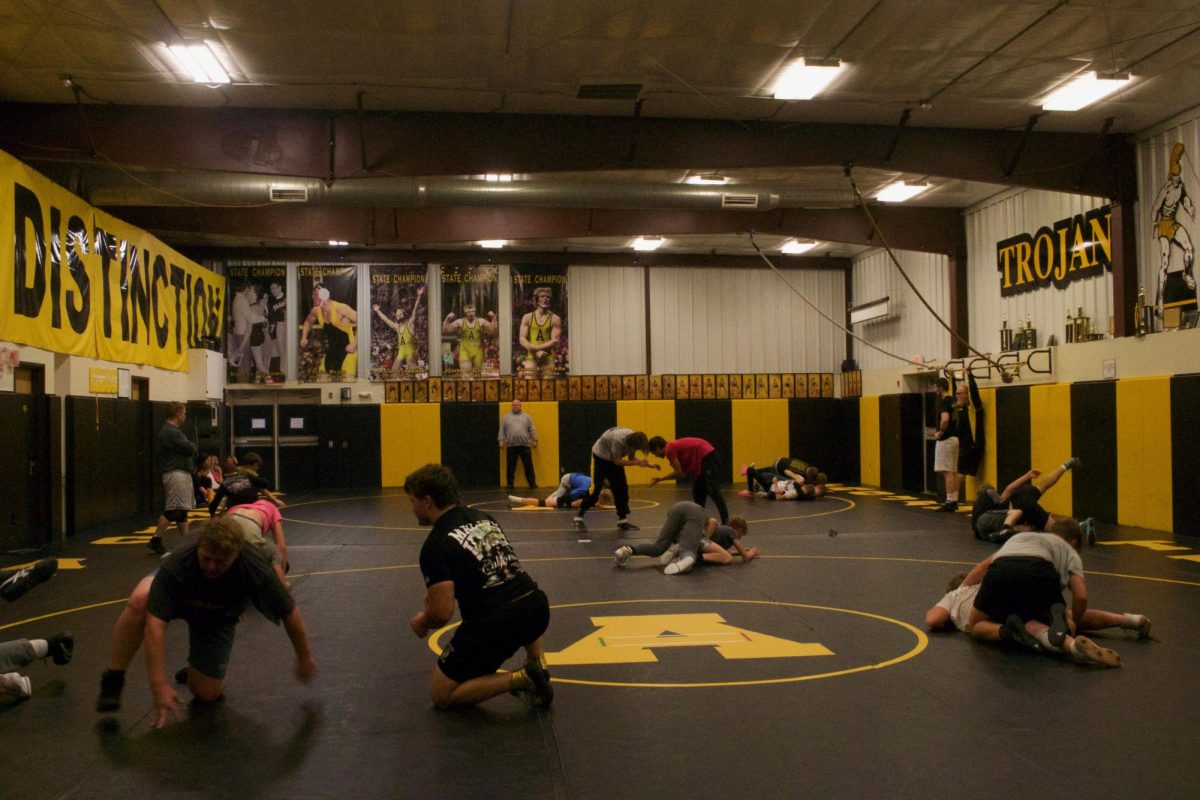
On Wednesday, November 26, the Atlantic boys’ wrestling team had its annual Hydration and Body Composition Testing. This assessment takes place every year, the day before Thanksgiving. The Body Composition Test, or “Fat Testing,” is required to be completed to wrestle for the IHSAA.
Firstly, the test must start with a hydration test. Hydration testing utilizes the wrestlers’ urine samples and is evaluated through discoloration. Once you pass the hydration test, the wrestlers move on to complete the Body Composition Test.
The “fat test” measures your body fat composition and ensures that an individual cannot descend below 7 percent body fat. The wrestler’s body composition is calculated by taking a caliber to a few parts of the wrestler’s body. After the fat test takes place, the examiner will input all the information and create a plan of action, deciding how low a wrestler’s weight can go.
Wrestlers prepare for this by cleaning up their diet and “putting on a few extra sweats on at practice,” said varsity wrestler Dreven Smith. The coaches really stress the importance of cleaning up diets as well as cutting out sodas/energy drinks, said Jesse McCann, the assistant wrestling coach at AHS.
Wrestlers often cut weight before the “fat test” takes place because the association only allows wrestlers to lose 1.5 percent of their body fat each week. 1.5 percent of body fat is usually about two pounds. Cutting before the fat test is important because “if you were needing to cut 20 pounds, it would take you 10 weeks rather than no time at all,” said varsity wrestler, Kalvin Hayes.
Varsity wrestlers place pressure on themselves during the preseason to reach a certain weight to perform well. “I put the pressure on myself to get a good weight class to advance and place at the state tournament,” said varsity wrestler Collin Harris. His goal as a wrestler this year is to place at the state tournament. He is working towards that goal by ensuring he can win his desired weight class.
McCann said that as a new wrestler, you must not stress cutting to a certain weight. “…We don’t make athletes ‘cut’ weight. It is more important to learn to love the sport and the technique. As for the assessment, just make sure you are hydrated, and the rest will take care of itself.”